Music World Premiere at The Royal Hospital For Neuro-Disability
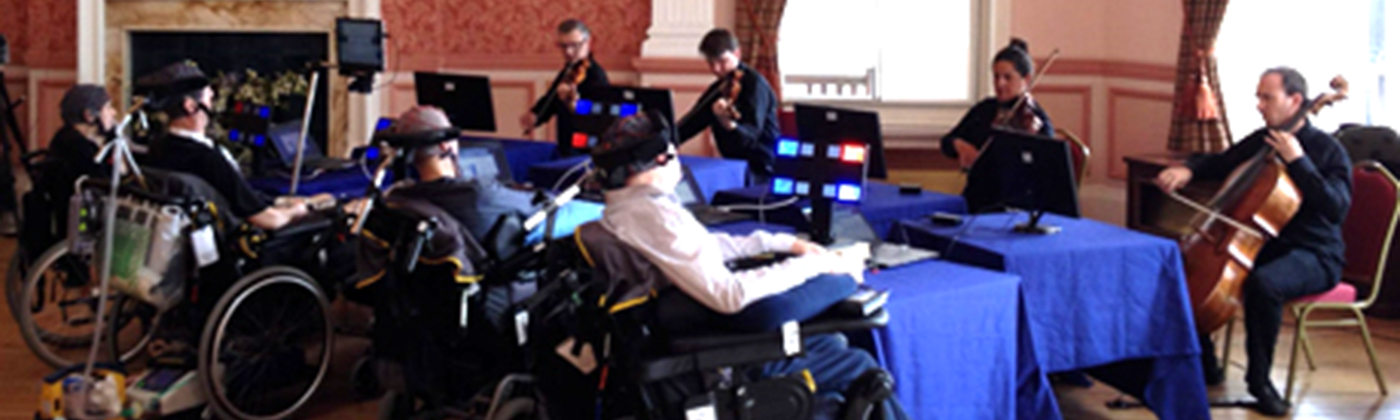 Four severely disabled patients played music with a string quartet using a Brain Computer Musical Interface
17 July saw the world premiere of the Paramusical Ensemble, the Bergersen Quartet playing collaboratively with four brain-injured people using the Brain Computer Musical Interface (BCMI), at the Royal Hospital for Neuro-disability (RHN) in Putney.
During the performance the four brain-injured people used the BCMI to generate the parts to be sight-read by the string quartet. Each of the four members of the BCMI quartet produced a score for a different player of the string quartet.
The initiative was led by composer Eduardo R. Miranda in collaboration with Joel Eaton (Interdisciplinary Centre for Computer Music Research, Plymouth University), Julian O’Kelly and Sophie Duport (Royal Hospital for Neuro-disability), and the Bergersen Quartet.
The BCMI device allows a brain-injured person to control musical systems with readings of their brainwave signals, detected with electrodes placed on the scalp directly above the occipital lobe (visual cortex).
The piece played by the Paramusical Ensemble was Activating Memory, composed by Prof. Miranda for the eight participants. As the music developed, the participants using the BCMI were given four options of musical phrases displayed on a panel, which they selected by staring at lights flashing next to them. The system detected which phrases they selected by reading the electrical activity of their visual cortex, and sent the selections to the string quartet to perform.
Steve Thomas, one of the patient musicians, said,
“It was a truly magical experience. It was a chance to play with other severely disabled musicians, and it actually sounded impressive.”
Dr Julian O’Kelly, RHN Research Fellow, said,
“It’s still early days in terms of the widespread application of the technology, but for many of the people that we work with every day at the RHN, this could be a very exciting development. It has the potential to really enhance their ability to get involved in the live composition and performance of music. As a practising music therapist working in brain injury rehabilitation, I’m really looking forward to seeing where this technology will take us.”